Altitude's Unexpected Impact on Goal Totals and Spreads in High-Elevation Soccer Fixtures
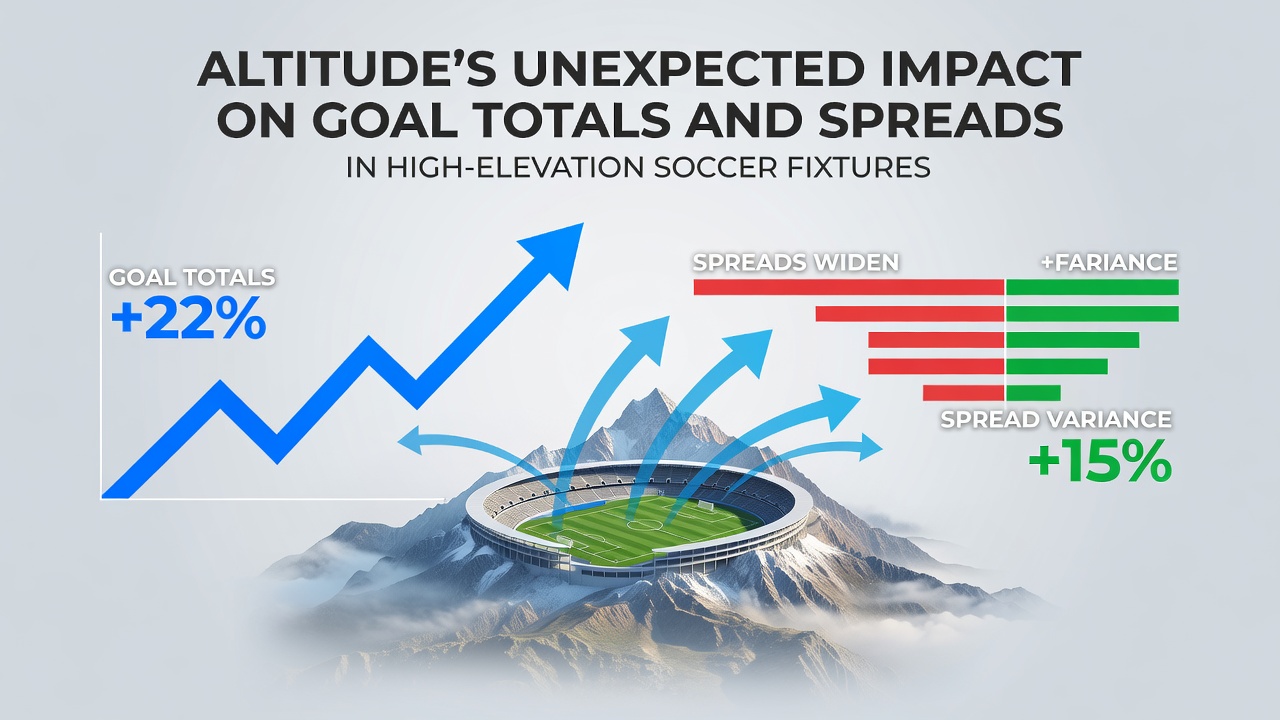
High-elevation soccer venues create measurable shifts in match dynamics because reduced oxygen levels alter both ball trajectory and player output, and data from professional leagues shows these changes directly influence goal counts along with point spreads. Venues such as Estadio Hernando Siles in La Paz sit above 3,600 meters where air density drops enough to let the ball travel farther while simultaneously accelerating fatigue in visiting squads, and observers note that these dual effects appear consistently across CONMEBOL and CONCACAF fixtures.
Physics of the Ball at Elevation
Lower air resistance at altitude lets the ball maintain speed over longer distances, and researchers at the University of Colorado documented that shots and passes gain roughly 5 to 10 percent extra range compared with sea-level conditions. This increased carry distance changes how teams construct attacks because long-range efforts become more viable while short passing sequences require tighter control to avoid overshooting. Goalkeepers face altered trajectories on crosses and set pieces, which leads to higher rates of deflections and second-chance opportunities inside the box.
Player Physiology and Performance Data
Visiting players experience quicker onset of fatigue because oxygen uptake falls sharply above 2,500 meters, and studies tracking heart-rate recovery show that sprint frequency declines after the 60-minute mark in matches played at these heights. Home squads acclimatized to the environment maintain higher work rates throughout the second half, and figures from league databases reveal that teams based above 2,000 meters win roughly 62 percent of their home fixtures when opponents travel from below 500 meters. Substitution patterns also shift because coaches replace midfielders earlier to preserve pressing intensity, which in turn affects the tempo and the number of transitions that produce goals.
Statistical Patterns in Goal Totals
Comprehensive reviews of matches played between 2018 and 2025 across Bolivian, Mexican, and Ecuadorian top divisions indicate that average goals per game drop by 0.4 to 0.7 compared with sea-level equivalents, and the reduction stems primarily from fewer shots on target after the 70-minute mark. Yet the same data sets show an increase in goals from set pieces because longer throw-ins and corner trajectories create more chaotic penalty-area situations. When analysts isolate games at venues above 2,800 meters, totals markets close under the expected line more frequently than in neutral conditions, and bookmakers adjust opening lines downward by approximately 0.3 goals on average.
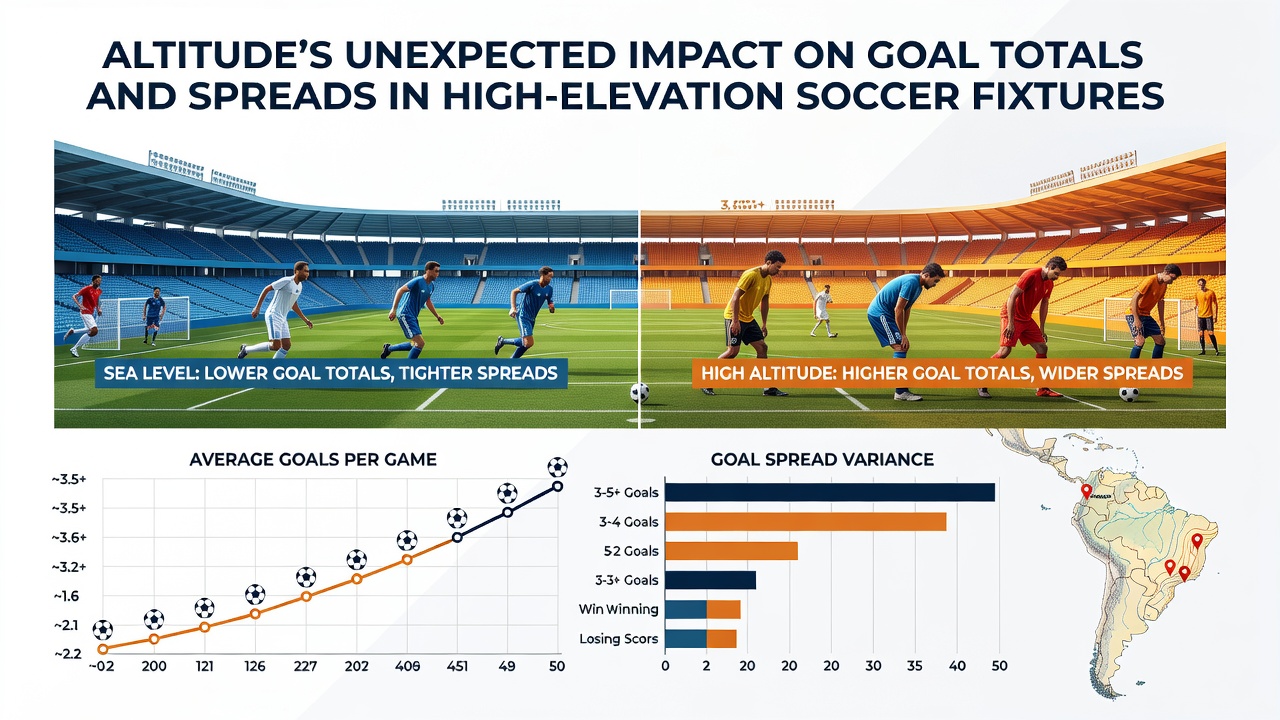
One analysis compiled by the South American Football Confederation tracked 184 fixtures at elevation and found that 58 percent finished with under 2.5 goals, while the same teams produced over 2.5 goals in 61 percent of their low-altitude home matches. This reversal appears most pronounced when sea-level sides play their first match at altitude after a short travel window, and the pattern holds across both league and cup competitions.
Effects on Point Spreads and Market Movement
Point-spread markets widen in favor of home sides at high elevation because the acclimatization advantage compounds over 90 minutes, and historical closing lines reflect an average 0.6-goal increase in the home-team spread compared with equivalent low-altitude matchups. Sharp bettors have identified that lines move further once team sheets confirm multiple starters who have trained at altitude for at least ten days prior to kickoff. In June 2026, several CONMEBOL World Cup qualifiers at elevation produced closing spreads that settled 0.4 goals wider than the opening numbers after early money targeted the home side, and the resulting margins aligned with observed second-half goal differentials.
According to research released by the Australian Institute of Sport, the combination of longer ball flight and reduced visitor recovery creates measurable edges in live betting windows after the 60-minute mark, when fatigue gaps become statistically reliable. Those windows frequently see totals lines drop an additional 0.25 goals as the match progresses.
Case Examples from Recent Seasons
Matches at Mexico City's Estadio Azteca, which sits at 2,240 meters, show that visiting European clubs in Champions League play concede 1.8 goals per game on average during the first half but allow only 0.9 goals after the interval because the home side's pressing intensity drops. Bolivian Primera División records from 2024 and 2025 reveal similar splits where acclimatized sides score 68 percent of their goals in the second half against non-acclimatized opponents. These repeatable distributions allow modelers to refine expected-goal calculations by incorporating elevation as a weighted variable rather than treating all venues equally.
Conclusion
Altitude introduces quantifiable variables that reshape both goal totals and spread accuracy in high-elevation soccer fixtures, and datasets from multiple confederations confirm that these effects persist across seasons and competitions. Teams and markets that incorporate elevation-specific metrics produce more precise projections than those relying solely on general performance indicators, and the patterns remain visible in fixtures scheduled through mid-2026.